Sacred Stones and Shared Skies: Exploring Kosovo's Extraordinary Legacy of Religious Architecture
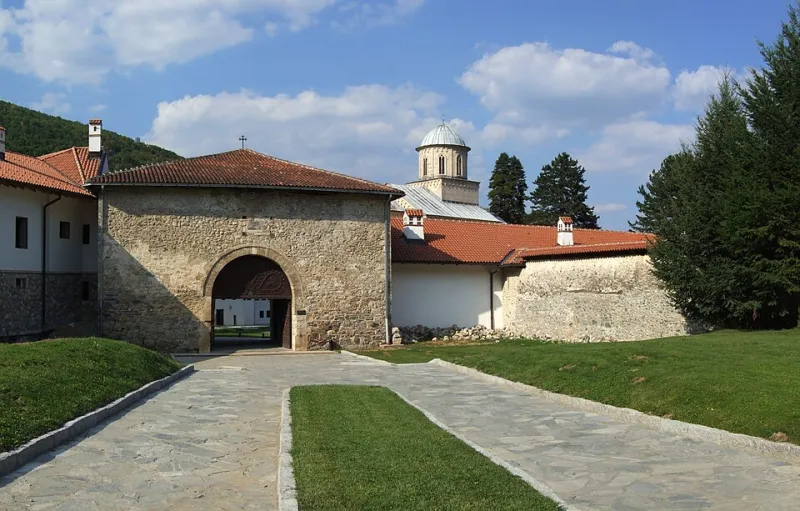
Photo: Pudelek (Marcin Szala), CC BY-SA 3.0, via Wikimedia Commons
There are places in the world where history does not simply exist in museums — it inhabits the walls, the floors, the very air of buildings that have been prayed in, fought over, and preserved across centuries. Kosovo is one of those places. In a territory roughly the size of Connecticut, you will find Ottoman mosques of extraordinary elegance, Serbian Orthodox monasteries decorated with Byzantine frescoes that art historians consider among the finest in Europe, and Catholic churches that speak to a religious tradition predating the region's Ottoman period by centuries.
For American travelers who have explored the great cathedrals of Western Europe or the ancient temples of the Mediterranean, Kosovo's religious heritage offers something qualitatively different: intimacy, complexity, and the unmistakable sense that you are encountering living history rather than a carefully curated exhibition. These are not ruins. Many of these sites remain active places of worship, tended by communities for whom faith and heritage are inseparable.
Understanding how to visit them — thoughtfully, respectfully, and with genuine curiosity — is the first step toward one of the most meaningful cultural experiences the Balkans has to offer.
The Ottoman Legacy: Mosques That Shaped a Civilization
Kosovo was incorporated into the Ottoman Empire in the late 14th century following the Battle of Kosovo — a conflict whose cultural and political resonance in the Balkans can scarcely be overstated. Over the centuries that followed, the Ottomans left an indelible architectural imprint on the region, constructing mosques, bazaars, hans (inns), and hammams that transformed the character of Kosovo's cities.
The most celebrated of these Islamic monuments is the Sinan Pasha Mosque in Prizren, constructed in 1615 and named after a grand vizier of the Ottoman Empire. The mosque sits at the heart of Prizren's old bazaar district, a remarkably well-preserved urban landscape that feels genuinely unchanged from its Ottoman-era configuration. The building's exterior is distinguished by its single minaret and its low, broad dome — a classical Ottoman form that speaks of an architectural tradition stretching from Istanbul to Cairo. Inside, the prayer hall is decorated with calligraphic inscriptions and geometric tilework of considerable refinement.
Prizren itself warrants extended attention. The city's historic center contains multiple mosques, a 16th-century Ottoman bridge, and the ruins of a Byzantine-era fortress that overlooks the entire valley. It is arguably Kosovo's most architecturally cohesive city and an essential stop on any heritage itinerary.
In Pristina, the Sultan Mehmet Fatih Mosque — also known as the Imperial Mosque — dates to the 15th century and is among the oldest Ottoman structures in the country. Its restrained exterior belies an interior of quiet dignity, and its central location in the capital makes it an accessible introduction to Kosovo's Islamic architectural heritage for visitors beginning their journey in Pristina.
Medieval Orthodoxy: Frescoes, Stone, and Sacred Silence
Long before the Ottomans arrived, Kosovo was the spiritual and political heartland of the medieval Serbian state. The monasteries built during this period — particularly those constructed under the patronage of the Nemanjić dynasty between the 12th and 14th centuries — represent a high-water mark of Byzantine-influenced Christian art and architecture.
The Visoki Dečani Monastery, located near the city of Peja in western Kosovo, is the most complete and best-preserved of these foundations. Inscribed on the UNESCO World Heritage List, Dečani was built in the 14th century and houses the marble tomb of its founder, King Stefan Dečanski. Its interior frescoes — covering more than 10,000 square feet of wall and ceiling space — depict biblical narratives, portraits of saints, and scenes from the life of Christ with a naturalistic expressiveness that anticipates the Italian Renaissance by several decades.
Visiting Dečani requires some planning. The monastery is an active Serb Orthodox community, and visitors are expected to dress modestly — shoulders and knees covered for both men and women. Photography policies vary and should be confirmed with the monks upon arrival. The site is managed in part by NATO's Kosovo Force (KFOR), which maintains a protective presence in the area; this should not deter visitors but does underscore the complex political context surrounding Kosovo's Orthodox heritage sites.
The Patriarchate of Peć, also near Peja and also inscribed on the UNESCO World Heritage List, is an even more evocative complex. A cluster of three interconnected churches built across the 13th and 14th centuries, the Patriarchate served as the seat of the Serbian Orthodox Church for centuries. Its frescoes, executed in multiple stylistic phases, offer a visual record of Byzantine art's evolution across a pivotal period of Christian history. The complex is set against a dramatic backdrop of forested hills at the entrance to the Rugova Canyon, making the approach by road a journey of growing anticipation.
Catholic Heritage: A Tradition Often Overlooked
Kosovo's Catholic community — predominantly ethnic Albanian and concentrated largely in certain regions of the country — maintains a religious tradition that predates the Ottoman period and has persisted through centuries of demographic and political change. While Catholic churches in Kosovo are less architecturally prominent than the region's mosques and Orthodox monasteries, they offer an important and frequently overlooked dimension of the country's religious landscape.
The Cathedral of Saint Mother Teresa in Pristina, completed in 2017, is the most prominent contemporary Catholic structure in Kosovo. Named in honor of the beloved humanitarian and Nobel Peace Prize laureate who was born in Skopje to Albanian parents with roots in the region, the cathedral has become both a place of worship and a symbol of Kosovo's Catholic identity. It is one of the largest Catholic churches in the Balkans and welcomes visitors of all backgrounds.
For those interested in older Catholic heritage, the villages of the Gjakova region contain small stone churches and chapels that speak to a rural Catholic tradition of considerable antiquity.
Practical Guidance for Visiting Sacred Sites
Kosovo's religious sites span multiple faith traditions, and respectful behavior is expected — and genuinely appreciated — at all of them. The following guidelines apply broadly across the country's sacred spaces:
Dress modestly. At mosques, women are typically asked to cover their hair, and both men and women should ensure their arms and legs are covered. At Orthodox monasteries, similar standards apply. Lightweight scarves and shawls are easy to carry and demonstrate cultural awareness.
Observe photography protocols. Some sites permit photography in exterior areas but prohibit it inside. Always ask before raising a camera, and respect the answer you receive.
Respect active worship. Many of these sites are not museums — they are living religious communities. If a service is in progress, wait quietly outside or observe from a respectful distance.
Engage with local guides. Hiring a local guide — many of whom are multilingual and deeply knowledgeable about the historical and theological context of these sites — enriches the experience considerably and supports the local economy.
A Heritage That Belongs to the World
Kosovo's religious architecture is not simply a record of one community's faith — it is a layered, sometimes contested, always compelling testament to the many civilizations that have called this territory home. For American travelers accustomed to thinking of the Balkans primarily through the lens of recent conflict, these sacred sites offer a more complete and nuanced picture: one of artistic achievement, spiritual endurance, and a shared human impulse to build something lasting in stone.
To walk through Dečani's frescoed nave, to stand in the courtyard of the Sinan Pasha Mosque at dusk, to light a candle in a small Catholic chapel in the western highlands — these are experiences that do not translate easily into photographs or social media captions. They require presence, patience, and a willingness to be moved. Kosovo, in this regard, rewards exactly the kind of traveler it deserves.