Where Empires Overlap: Kosovo as Europe's Most Overlooked Civilizational Crossroads
There is a particular kind of travel experience that no guidebook can fully prepare you for — the moment you realize that the place you are standing holds more history than almost anywhere you have ever been, and that almost no one you know has been there. Kosovo produces that feeling with unusual frequency.
Nestled at the geographic heart of the Balkan Peninsula, Kosovo occupies a position that cartographers and conquerors have recognized for millennia. It sits at the meeting point of roads that once connected Constantinople to the Adriatic, the Roman Empire to the eastern frontier, and, in more recent centuries, the secular West to the Ottoman world. That convergence was not accidental. It was geological, political, and ultimately cultural — and its effects are visible everywhere a traveler chooses to look.
A Layered Landscape, Literally
The town of Ulpiana, located just outside Pristina, offers one of the clearest illustrations of Kosovo's civilizational depth. Founded as a Roman municipium in the first century CE, it grew into one of the most significant urban centers in the Roman province of Moesia Superior. Excavations have revealed colonnaded streets, public baths, early Christian basilicas, and a sophisticated water supply system — all of it sitting quietly beneath fields that most international visitors drive past without a second glance.
What makes Ulpiana particularly compelling is not simply its age but its continuity. The site was rebuilt after an earthquake in the sixth century under the Byzantine emperor Justinian I, who renamed it Justiniana Secunda. Layers of occupation — Roman, Byzantine, medieval Serbian — are legible in the stonework itself. For American travelers accustomed to history measured in hundreds rather than thousands of years, walking Ulpiana's excavated avenues carries a weight that is difficult to articulate and nearly impossible to forget.
Similar layering appears at the Gadimë Cave in the Lipjan municipality, where geological time replaces human history as the primary measure of depth. Stalactites and stalagmites formed over millions of years create an underground landscape that feels entirely removed from the political and cultural dramas above. Yet even here, the cave's discovery in 1969 and its subsequent development as a visitor attraction reflects Kosovo's broader effort to present its natural and historical inheritance to the world on its own terms.
The Ottoman Imprint and Its Enduring Architecture
No honest account of Kosovo's cultural identity can sidestep the Ottoman period, which lasted roughly five centuries and left an imprint that remains visible, audible, and deeply felt. The old bazaar district of Pristina — known locally as Çarshia — retains the spatial logic of a classical Ottoman market town, with narrow lanes, artisan workshops, and the kind of unhurried commercial rhythm that feels increasingly rare in contemporary Europe.
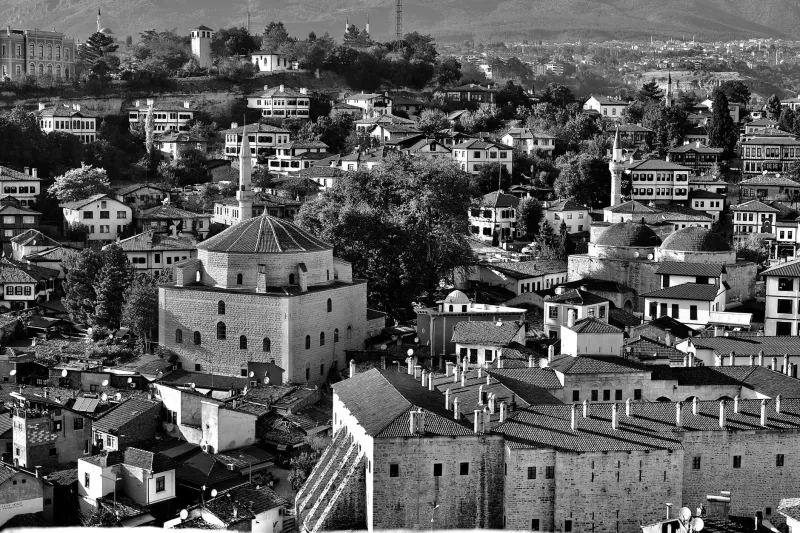
The Sinan Pasha Mosque in Prizren, constructed in 1615, represents one of the finest examples of classical Ottoman religious architecture in the western Balkans. Its proportions are spare and confident, its stonework a warm honey color in afternoon light. Prizren itself is arguably the single most concentrated expression of Kosovo's multicultural inheritance: Ottoman mosques, an Orthodox monastery, a Catholic cathedral, and a synagogue occupy a compact urban center where multiple communities have coexisted — not always without tension, but with a proximity that has produced genuine cultural exchange over generations.
The League of Prizren Museum, housed in the building where Albanian national leaders gathered in 1878 to resist the partition of Albanian-inhabited lands, adds a further dimension. Here, the Ottoman political framework becomes the backdrop against which modern Albanian national identity was first articulated. Understanding that moment is essential for any visitor who wants to make sense of Kosovo's position in contemporary European politics.
Byzantine Frescoes and the Medieval Serbian Kingdom
Kosovo's medieval heritage is equally formidable, anchored by a series of Serbian Orthodox monasteries whose frescoes rank among the finest examples of Byzantine art anywhere in the world. The Patriarchate of Peć, a UNESCO World Heritage Site, houses three interconnected churches whose painted interiors date from the thirteenth and fourteenth centuries. The figures rendered on those walls — saints, rulers, angels — possess a psychological intensity that stops visitors mid-step.
The Visoki Dečani Monastery, also a UNESCO site, contains what is widely regarded as the largest and best-preserved medieval fresco cycle in the Balkans. More than a thousand individual compositions cover the interior walls of the main church, telling biblical narratives with a visual sophistication that anticipates the Italian Renaissance by decades. That this artistic achievement exists in a country most Americans cannot locate on a map is one of travel's more humbling revelations.
For visitors approaching these sites from a secular perspective, the experience need not be devotional to be profound. The monasteries function as archives — of artistic technique, of medieval political theology, of the human need to render the invisible visible. They are, in the fullest sense, primary sources.
Where History Becomes Personal
Kosovo's most recent chapter — the conflict of the late 1990s, the declaration of independence in 2008, the ongoing process of international recognition — is not separate from its ancient history. It is continuous with it. The Kosovo Museum in Pristina traces this entire arc, from prehistoric Vinča culture artifacts through Roman and medieval collections to documents and photographs from the twentieth century. Few national museums anywhere in Europe cover so much civilizational ground in a single building.
What distinguishes Kosovo from other historically layered destinations is the living quality of its inheritance. The cultures that passed through this territory did not simply leave ruins. They left communities, languages, culinary traditions, religious practices, and family memories that remain active in the present. A traveler who takes the time to engage with that living dimension — to sit in a Prizren coffeehouse, to attend a concert at the Dodona Theatre in Pristina, to visit a craft workshop in Gjakova's old bazaar — will encounter something that no museum exhibit can fully replicate.
A Front-Row Seat, Finally Available
For American travelers who have exhausted the familiar European itinerary and are looking for a destination that rewards genuine curiosity, Kosovo presents a compelling case. The infrastructure for independent travel is increasingly solid: Pristina's Adem Jashari International Airport receives direct flights from several European hubs, accommodation options range from boutique guesthouses to well-appointed hotels, and English is widely spoken among younger residents.
The investment required — in time, in openness, in a willingness to engage with complexity — is real. But so is the return. Kosovo does not offer the polished, pre-interpreted experience of a destination that has been receiving mass tourism for generations. What it offers instead is something more valuable: direct, unmediated access to one of the most consequential meeting points in European history, at a moment when that access is still uncrowded, unhurried, and entirely genuine.