Disconnected by Design: How Kosovo Became the Antidote to the Always-On American Traveler
There is a particular kind of exhaustion that follows the modern American traveler home. It is not the good tiredness of long walks and late dinners. It is the hollow fatigue of having been everywhere and absorbed nothing—of having stood in front of wonders while composing captions, of having eaten meals that were photographed before they were tasted. Somewhere between the curated feed and the five-star review, the journey itself got lost.
Kosovo does not offer a cure for this, exactly. What it offers is something more honest: a destination that simply never built the apparatus that causes the problem in the first place.
The Absence of Infrastructure as Invitation
Visitors arriving in Kosovo for the first time often notice what is not there before they notice what is. There are no rope lines organizing them into photogenic queues. There are no augmented-reality overlays turning medieval monasteries into gamified experiences. The old bazaars of Prizren and Gjakova were not restored for the benefit of a travel magazine shoot—they were restored because the people who live and work in them wanted them back.
This absence is not a deficiency. It is, for the traveler who has grown weary of destinations engineered for maximum shareability, an extraordinary gift.
Slow travel as a philosophy has been written about extensively in American publications over the past decade, usually as an aspirational correction to the highlight-reel approach that social media has normalized. The prescription is familiar: stay longer, move less, resist the checklist. What those articles rarely acknowledge is that slow travel is genuinely difficult to practice in destinations that have been optimized to funnel you from attraction to attraction at a commercially convenient pace. Kosovo, by contrast, has not been optimized for anything except the rhythms of its own daily life—and that rhythm, it turns out, is precisely what the burned-out American traveler needs.
What Prizren Does to a Schedule
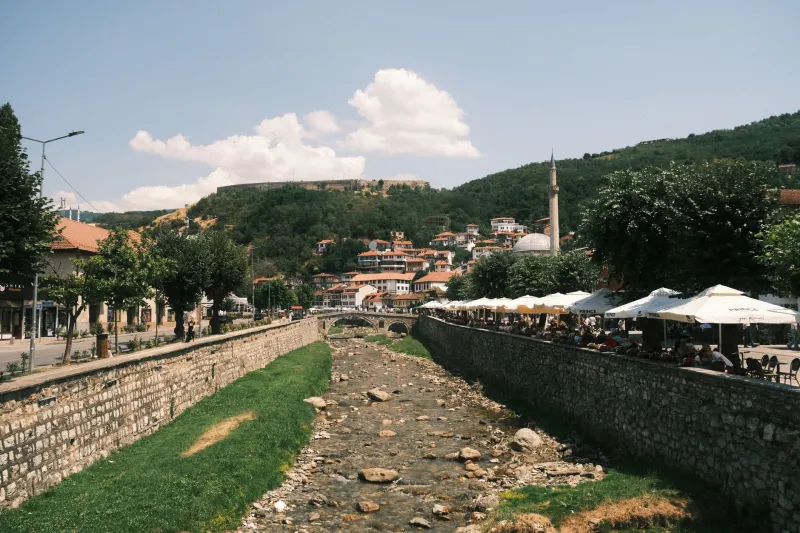
Consider a morning in Prizren, Kosovo's most visited city and, by any reasonable measure, one of the most beautiful towns in the Balkans. You wake without an agenda. The call to prayer drifts across the rooftops. The Bistrica River moves through the old quarter with the unhurried certainty of something that has been doing this for centuries. A café near the stone bridge serves coffee the way Kosovars have always served it: slowly, in small cups, as a pretext for conversation rather than caffeine delivery.
There is no app telling you that the fortress closes in forty minutes. There is no line of tour buses disgorging identically-scheduled groups at the Orthodox church on the hill. The fortress will be there when you get there. So will the church. So will the baker who has been pulling bread from the same oven since before you were born.
At some point in the morning, you realize you have not checked your phone. Not because you made a principled decision to put it away, but because nothing about your surroundings has demanded that you do so. Prizren does not perform for visitors. It simply exists, and the visitor is welcome to exist alongside it.
The Sociology of Not Being Watched
There is a sociological dimension to Kosovo's slow-travel advantage that deserves more attention than it typically receives. In overtourism destinations—the Amalfi Coasts and Dubrovniks of the world—visitors exist within a system that has been designed to process them. Every interaction has been commodified. Every vista has been claimed by a thousand identical photographs. The traveler is, in a very real sense, a consumer moving through a consumption environment.
Kosovo's relationship with its visitors is structurally different. Tourism here is still young enough that most encounters between locals and travelers retain an element of genuine curiosity. When a family in a village near Rugova Canyon invites you to sit and share whatever is on the table, they are not executing a hospitality protocol. They are doing what Kosovars do, which is to treat the presence of a guest as an occasion worth honoring. The American traveler, accustomed to a world in which every service interaction has a rating attached to it, often finds this disorienting before finding it profound.
This is not a transaction. It is a relationship, however brief. And relationships, unlike transactions, require you to be present.
Nature That Asks Something of You
Kosovo's natural landscapes reinforce this imperative toward presence in ways that are less philosophical and more physical. The Sharr Mountains in the south, the Accursed Mountains along the northern border, the wetlands of the Drini i Bardhë valley—these are not places that have been packaged into convenient half-day excursions. They are places that require preparation, attention, and a willingness to accept that the trail will not have a gift shop at the end of it.
For American hikers accustomed to the well-maintained infrastructure of national parks—the marked trailheads, the ranger stations, the laminated maps at every junction—Kosovo's wilderness can initially feel underserved. With a modest adjustment of expectation, it reveals itself as something far more valuable: terrain that has not yet been domesticated for recreational consumption. You navigate by landmarks and local knowledge. You pay attention because inattention has consequences. You arrive at a summit or a canyon overlook having earned it, and the view means something different because of that.
The Permission You Did Not Know You Needed
American travelers are, culturally speaking, not always comfortable with unstructured time. The Protestant work ethic does not dissolve at passport control. Many visitors arrive in Kosovo with the same productivity-oriented approach they bring to everything else: maximize, optimize, document. The first day or two can produce a low-grade anxiety—a sense that something should be happening, that the day is not being used correctly.
Kosovo has a way of dissolving this anxiety without confronting it directly. The country simply does not provide the stimuli that feed it. There is no leaderboard of must-see attractions. There is no social pressure to have visited the right café or taken the approved photograph. What fills the space instead is the texture of ordinary life: the sound of a çifteli being played somewhere down an alley, the smell of flija cooking in a courtyard, the particular quality of light on Ottoman-era stone in the late afternoon.
These are not Instagram moments. They are something better—moments that belong entirely to the person experiencing them, unreproducible and untransferable.
Coming Home Different
Travelers who spend real time in Kosovo—not a rushed two-night stopover but a week or more of genuine immersion—frequently describe the return to American life in similar terms. The noise is louder. The pace feels arbitrary. The compulsion to document everything seems, for a little while at least, slightly absurd.
This is what slow travel is supposed to do, and it is what Kosovo, without trying particularly hard, consistently delivers. Not because the country has designed a slow-travel product, but because it has not yet designed away the conditions that make slowness possible.
That window will not remain open indefinitely. Kosovo's tourism sector is growing, and growth, managed well, is a good thing for the country and its people. But for the American traveler arriving now, the timing is genuinely fortunate. You are here before the optimization. Before the rope lines and the augmented reality and the influencer queues.
Put the phone away. The moment is not going anywhere.