A Cup at the Center: How Kosovo's Coffee Ritual Unlocks the Soul of Balkan Life
In the United States, coffee is often a transaction: a tall cup grabbed on the way to somewhere else, consumed behind a steering wheel or at a standing desk. In Kosovo, that framing dissolves entirely. Here, coffee is a commitment—a deliberate pause in the day, a reason to sit with another person, and a quiet declaration that the conversation you are about to have matters more than whatever comes next.
For travelers arriving from American cities where café culture tends toward the solitary and screen-focused, Kosovo's kafja scene offers something genuinely disorienting in the best possible way: a public space where people actually talk to one another, where the same table might be occupied for two hours over a single macchiato, and where the barista knows not just your order but your name, your neighborhood, and the status of your extended family.
The Architecture of the Daily Ritual
Kosovo's coffee tradition draws from two deep wells. The first is Ottoman-era qahvehane culture, in which coffeehouses functioned as civic institutions—places where men debated politics, conducted commerce, and composed poetry over tiny cups of thick, unfiltered brew. The second is a more recent European influence, particularly from Italy and Austria, that introduced espresso machines and the sleek, glass-fronted aesthetic that now defines Pristina's main boulevard, Bulevardi Nënë Tereza.
The result is a coffee culture that feels both ancient and contemporary. In the same afternoon, a visitor might drink a traditional Turkish-style coffee—prepared in a džezva, served with a small square of lokum on the side—at a generations-old establishment in the old bazaar district, then walk ten minutes to a specialty third-wave café where single-origin beans are sourced from Ethiopia and brewed with the precision of a science experiment.
Both experiences are authentically Kosovar. The country has absorbed influences without surrendering its own character, and nowhere is that synthesis more evident than in its coffee shops.
What to Order and How to Order It
For first-time visitors, navigating the menu requires a brief orientation. The default espresso—called simply kafe ekspres—is short, strong, and served without ceremony in a demitasse cup. It is the workhorse of the daily ritual and the appropriate choice when you want to signal that you understand the local code.
Macchiato (kafe macchiato) is arguably the most popular order among younger Kosovars, prepared with a generous cloud of steamed milk that softens the espresso's edge without turning it into the oversized, syrup-laden beverages that dominate American coffee chains. If you order a macchiato in Kosovo, expect something closer to what an Italian would recognize—small, balanced, and finished in a few sips.
Traditional Turkish coffee remains widely available and culturally significant, particularly in the western city of Peja and in smaller towns where the Ottoman tradition runs deeper. It arrives unfiltered, so allow the grounds to settle before drinking, and resist the American impulse to stir.
Cold coffee (kafe e ftohtë), a sweetened iced espresso shaken into a frothy, milky drink, has become enormously popular during summer months. It bears a passing resemblance to a Vietnamese iced coffee and is an excellent choice for visitors exploring Kosovo's outdoor markets or mountain towns in July and August.
The Kafja as Community Infrastructure
To understand why Kosovo has more cafés per capita than almost anywhere in Europe, you have to understand what the kafja actually does. It functions, in sociological terms, as a third place—neither home nor workplace, but the informal civic space where community is actively constructed and maintained.
In Pristina, the concentration of cafés along Bulevardi Nënë Tereza creates an outdoor living room that stretches for nearly a kilometer. On any given morning, that boulevard holds students preparing for university exams, retired professionals debating the day's newspaper, young professionals conducting informal business meetings, and tourists trying to figure out where they are. The kafja does not segregate these groups. It holds them together.
In smaller towns, the dynamic is even more pronounced. In Prizren, Kosovo's most visually captivating city, the kafjas clustered along the Bistrica River serve as the social nervous system of a community that is simultaneously medieval and modern. In Gjilan, in the country's southeast, café terraces fill by mid-morning and remain occupied well into the evening, with the same patrons cycling through multiple rounds of conversation and coffee across the course of a single day.
Where to Go: A Selective Guide for American Visitors
In Pristina, Soma Book Station on Rexhep Luci Street has become a cultural landmark—part bookshop, part gallery, part specialty café—that draws a creative and intellectually engaged crowd. It is an ideal introduction to the city's contemporary cultural energy and a good place to meet English-speaking locals.
Dit' e Nat' (Day and Night), located near the Grand Hotel, is one of Pristina's most storied kafjas, a gathering place for journalists, artists, and politicians that has functioned as an informal salon for decades. The coffee is excellent; the people-watching is exceptional.
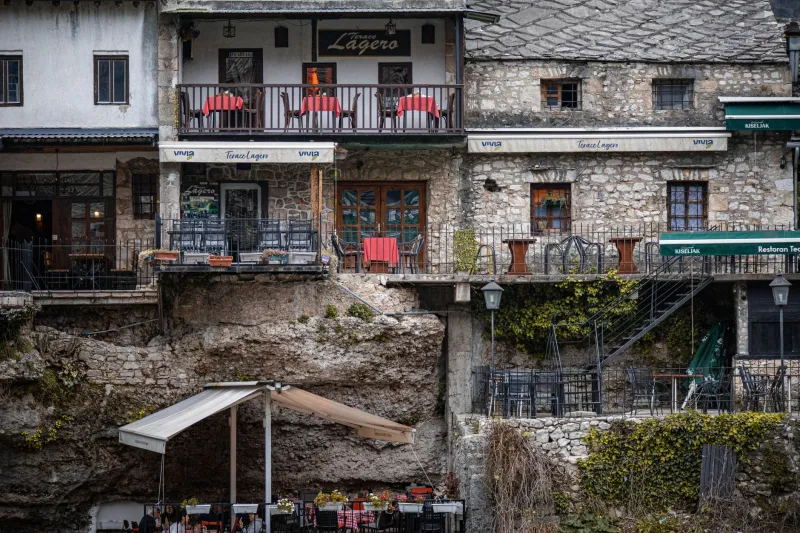
In Prizren, the riverside kafjas near the Sinan Pasha Mosque offer perhaps the most atmospheric setting in the country—stone bridges, Ottoman-era architecture, and the sound of the Bistrica running beneath your feet. Arrive in the late afternoon, when the light softens and the terraces fill.
For visitors willing to venture into smaller towns, the unmarked neighborhood kafjas of Vushtrri or Suhareka offer something that the Pristina establishments, however excellent, cannot fully replicate: the experience of being the only foreigner in the room, welcomed without fanfare into the ordinary social life of a Kosovar community.
The Etiquette of Slowing Down
American visitors sometimes feel a mild social pressure to finish quickly and vacate the table. In Kosovo, that instinct should be consciously set aside. Lingering is not rude; it is the point. A kafja table is not a resource to be turned over—it is a space to be inhabited.
Paying the bill requires a similar adjustment. Splitting a check is uncommon; Kosovars tend to take turns paying in full, a practice rooted in a hospitality ethic that treats generosity as a social obligation rather than a financial calculation. If a local insists on paying for your coffee, accept graciously. The appropriate response is not protest but a reciprocal invitation next time.
Kosovo's coffee culture is, in the end, a lesson in presence. It asks visitors to slow down, to sit across from another person without an agenda, and to discover what happens in the space that opens up when the transaction is removed from the experience. For travelers accustomed to the speed of American daily life, that lesson can feel surprisingly profound—delivered, appropriately enough, in a very small cup.