Bread, Memory, and the Table: A Journey Through Kosovo's Living Culinary Tradition
There is a particular moment that many food travelers describe after visiting Kosovo for the first time. It happens at a kitchen table, usually in a farmhouse or a modest urban apartment, when a host places before them a dish that required hours of preparation—perhaps a layered burek pulled from a wood-fired oven, or a slow-cooked lamb stew fragrant with dried herbs gathered from a nearby hillside—and then sits down not to watch, but to eat alongside them. The meal is not a performance. It is an act of inclusion.
Kosovo has not yet appeared on the radar of most American food travelers, who tend to associate Balkan cuisine with the more internationally marketed traditions of Greece or Croatia. That unfamiliarity is, paradoxically, one of the country's greatest assets. The culinary landscape here remains largely unmediated by tourism: the recipes are old, the ingredients are local, and the cooks are telling their own stories on their own terms.
The Architecture of a Kosovar Meal
Understanding Kosovar food requires a brief reckoning with geography and history. Kosovo sits at a crossroads where Ottoman, Slavic, and Albanian culinary traditions have been layering over one another for centuries, producing a cuisine that is simultaneously distinct and deeply connected to its neighbors. The Ottoman inheritance is visible in the prevalence of phyllo pastry, slow-braised meats, and the generous use of dairy—particularly the thick, slightly sour kajmak, a clotted cream that accompanies everything from grilled meats to fresh bread.
The Albanian culinary tradition, which forms the cultural backbone of Kosovo's majority population, contributes a pastoral sensibility rooted in livestock farming, seasonal vegetables, and preservation techniques developed out of necessity during long mountain winters. Fermented foods—pickled cabbage, brined peppers, dried beans—are not a trend in Kosovo. They are a survival strategy elevated to an art form.
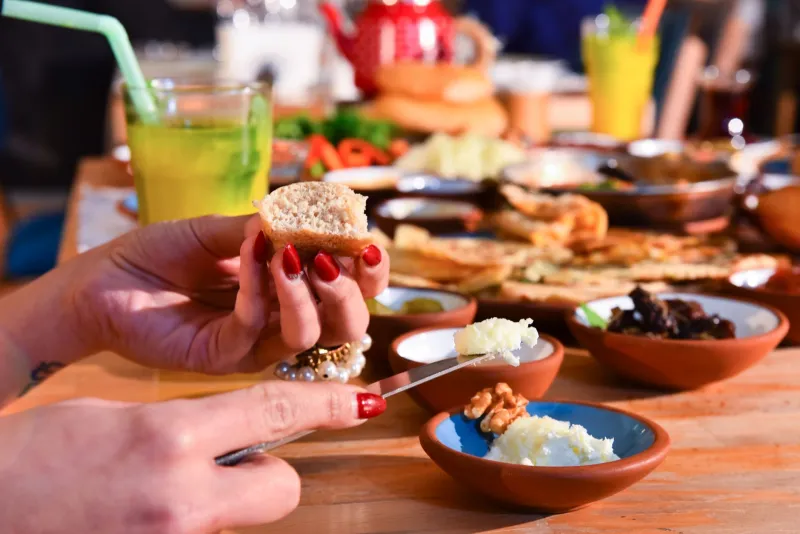
Meals tend to follow a structure that American visitors may find unfamiliar in its generosity. A typical home dinner begins with a spread of cold dishes—turshi (pickled vegetables), fresh white cheese, olives, and sliced cured meats—that would constitute a complete meal in most other contexts. These are followed by a soup course, then a main dish of grilled or braised meat, and finally a dessert that almost always involves honey, walnuts, or both.
Burek and Pite: The Architecture of Phyllo
If Kosovo has a national dish, the debate would be fierce and unresolved, but burek would place near the top of most lists. A cylindrical coil of paper-thin phyllo dough wrapped around a filling of seasoned ground meat, fresh cheese, or spinach, then baked until golden and flaky, burek is both a breakfast staple and a late-night institution. It is sold by weight at burekxhinjte—dedicated burek shops—that open before dawn and often sell out before noon.
Pite, a broader category of savory phyllo pies, encompasses regional variations that could occupy an entire research paper. In the Dukagjini valley in western Kosovo, pite me kungull (pumpkin pie, savory rather than sweet) is prepared with a filling of roasted squash, onions, and a generous hand of black pepper. In the Drenica region, home cooks favor pite me lakër—a cabbage pie that is humble in its ingredients and extraordinary in its execution when prepared well.
Fatmire Hoxha, a home cook in the village of Klinë who learned her recipes from her grandmother during the 1980s, describes the process of stretching phyllo dough by hand as something closer to a meditative practice than a culinary technique. "You cannot rush it," she explains. "The dough tells you when it is ready. If you pull too fast, it tears. You have to feel it." Hoxha now hosts small groups of visitors in her home kitchen, walking them through the process while narrating the family histories embedded in each dish.
The Fermentation Legacy
Long before fermented foods became a wellness trend in American grocery stores, Kosovar families were preserving the summer harvest in ceramic jars and wooden barrels as a matter of practical necessity. The tradition continues with an intensity that reflects both cultural pride and genuine culinary preference.
Turshi, the collective term for Kosovo's pickled vegetable repertoire, varies significantly by region and family. In some households, the brine is simple—water, salt, and time. In others, it incorporates wild herbs, dried chili peppers, or grape leaves that impart a subtle tannin. The resulting products range from crisply acidic to deeply complex, and they appear on virtually every table in the country as a counterpoint to the richness of grilled meats and dairy.
In the mountain town of Dragash, near Kosovo's border with North Macedonia, the culinary tradition incorporates influences from the local Gorani community—a South Slavic group whose cuisine bridges Kosovo and Macedonian traditions. Here, fermented dairy products take on additional significance: meze spreads built around aged cheeses and cultured creams are prepared with a specificity that reflects generations of refinement.
Where the Stories Live: Finding Authentic Food Experiences
For American visitors accustomed to seeking out food experiences through restaurant review platforms and influencer recommendations, Kosovo requires a different approach. The most significant culinary encounters are rarely found in formal restaurants. They happen in agritourism homesteads, at weekly markets, in the back rooms of family-run guesthouses, and occasionally at the roadside stands that appear without warning along mountain passes.
The Prizren Old Bazaar hosts a Wednesday market where local producers sell seasonal vegetables, homemade cheeses, and prepared foods that vary by the week and the harvest. Arriving early—before nine in the morning—means encountering vendors who are still arranging their displays and are generally more willing to stop and talk.
In the Rugova Canyon near Peja, several family-owned guesthouses have developed food-focused programs that pair hiking excursions with meals prepared entirely from ingredients grown or raised on the property. Grilled trout from the canyon's clear-running streams, served with roasted peppers and fresh bread baked in a saç (a traditional domed lid covered with embers), constitutes one of the more memorable meals available anywhere in the Balkans.
In Pristina, the neighborhood of Ulpiana has quietly developed a cluster of restaurants and informal eateries that draw on traditional recipes while accommodating contemporary tastes. Several are operated by young Kosovar chefs who trained abroad and returned with technical skills they are now applying to the ingredients and flavors of their childhoods.
The Hospitality Imperative
No account of Kosovar food culture is complete without addressing besa—an Albanian concept of sacred hospitality that carries the force of a moral obligation. When a Kosovar host invites you to eat, the invitation is not casual. It is a covenant. The food placed before you represents not only culinary skill but a statement of values: that the guest is sacred, that generosity is its own reward, and that the table is the place where strangers become, at least temporarily, family.
For American travelers navigating a world that often feels transactional and hurried, sitting down at a Kosovar table can be a quietly transformative experience. The food is genuinely excellent. But the deeper nourishment comes from something harder to quantify—the sense that you have been seen, welcomed, and fed by people for whom hospitality is not a service but a way of being in the world.