Longer Than a Vacation, Shorter Than Forever: How Americans Are Building Lives in Kosovo One Year at a Time
Most Americans who land in Pristina for the first time arrive with a two-week itinerary and leave quietly reconsidering their entire life plan. That is not a metaphor. It is, increasingly, a documented pattern — one that Kosovo's residency offices, expat Facebook groups, and downtown apartment landlords can confirm with anecdotal precision.
The conversation around Kosovo and long-term stays has largely been dominated by the country's Startup Visa, a well-publicized program designed to attract foreign entrepreneurs. But that program is only one entry point in a broader, less-advertised framework of residency options that Americans are beginning to navigate with real success. For remote workers, freelancers, retirees on fixed incomes, and professionals between chapters, Kosovo's legal pathways for extended stays represent one of the most practical — and least crowded — opportunities in Europe.
What the Startup Visa Doesn't Tell You
Kosovo's Law on Foreigners establishes several categories of temporary residence that apply directly to Americans seeking stays beyond the standard 90-day visa-free period. Temporary residence permits can be issued for purposes including employment, family reunification, property ownership, and study — but the category that draws the most quiet interest among location-independent Americans is the one tied to self-sufficiency and passive income.
Under existing regulations, foreign nationals who can demonstrate financial self-sufficiency — typically through documented income from abroad, investments, or pension disbursements — may apply for a temporary residence permit without needing to establish a local business entity. The process involves submitting proof of income, a clean criminal background check, valid health insurance, and a registered address in Kosovo. Processing times are generally measured in weeks, not months, and the associated fees are modest by any standard.
For Americans accustomed to the labyrinthine immigration bureaucracies of Western Europe, Kosovo's system can feel almost disarmingly straightforward.
The Cost Calculation That Changes Everything
Pristina's cost of living regularly surprises first-time visitors. A furnished one-bedroom apartment in a central neighborhood rents for roughly $300 to $500 per month. A sit-down lunch at a local restaurant rarely exceeds $6. Monthly grocery costs for a single person living comfortably hover around $150 to $200. Reliable high-speed internet — the non-negotiable infrastructure of remote work — is both widely available and inexpensive.
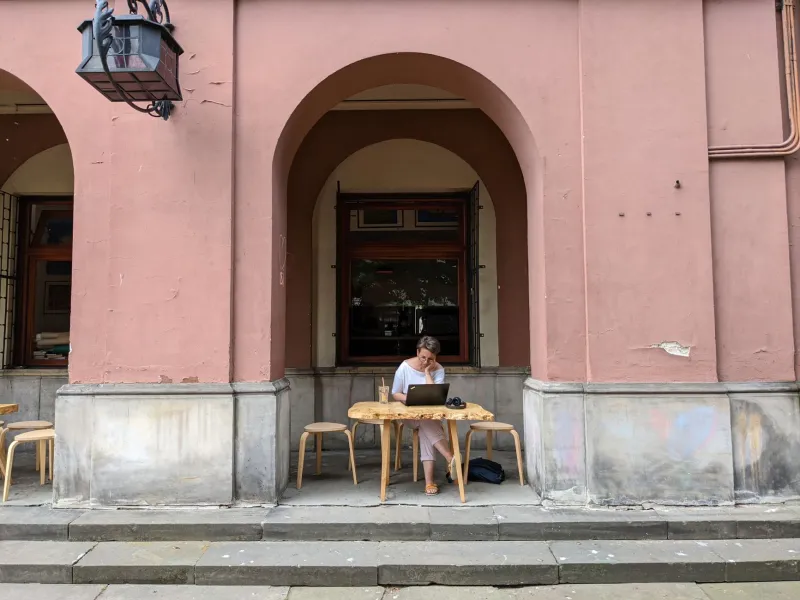
For Americans earning in dollars while spending in euros at Kosovo's price levels, the financial arithmetic is compelling. A remote worker earning $4,000 per month from a US-based employer can live exceptionally well in Pristina while saving at a rate that would be impossible in virtually any American city — and most Western European capitals.
This is not a secret that Kosovo is trying to keep. It is simply a reality that has not yet reached mainstream American awareness.
Real People, Real Relocations
Americans who have made the move tend to describe a common sequence of events: a short visit that extended into a month, a month that became three, and a growing reluctance to return to a life that suddenly felt more expensive and more crowded than necessary.
Some arrive as digital nomads testing the waters. Others come following a job loss, a divorce, or a retirement that arrived earlier than planned. A number are drawn by Kosovo's historical and cultural complexity — the same layered identity that draws thoughtful travelers also sustains long-term residents who find the country intellectually engaging in ways that more polished tourist destinations rarely are.
What they tend to share is a discovery that Kosovo's social fabric is unusually welcoming to foreign residents. The country's deep cultural affinity for the United States — rooted in the history of the late 1990s and sustained through decades of diplomatic and personal ties — means that American residents are rarely treated as outsiders. Integration, while never without friction, tends to happen faster than expatriates anticipate.
Healthcare, Banking, and the Practical Infrastructure of Daily Life
Two concerns surface consistently among Americans considering a longer stay in Kosovo: access to healthcare and the mechanics of banking.
On healthcare, Kosovo operates both a public system and a growing private sector. Private clinics in Pristina offer consultations and diagnostic services at costs that are a fraction of US out-of-pocket rates. Many American long-term residents purchase international health insurance policies — products from providers like SafetyWing or Cigna Global — that cover them throughout Kosovo and provide emergency evacuation coverage if needed. Dental care, in particular, draws medical travelers from across the region; American residents frequently cite high-quality dental work at dramatically reduced prices as an unexpected benefit of their relocation.
Banking presents a slightly more complex picture. Kosovo uses the euro as its currency, which eliminates exchange rate friction for residents managing European transactions. Opening a local bank account as a foreign national requires a residence permit, which creates a logical sequence: secure your permit, then establish your banking relationship. In the interim, US-based accounts with low foreign transaction fees — Charles Schwab's checking account is frequently mentioned in expat communities — provide workable bridge solutions.
On the question of US taxation, the picture is important to understand clearly: Americans living abroad remain subject to US tax obligations regardless of where they reside. However, the Foreign Earned Income Exclusion (FEIE) allows qualifying Americans to exclude a significant portion of foreign-earned income from US taxation. Consulting a tax professional experienced in expat financial planning is strongly recommended before making any long-term relocation decision.
The City as a Living Space
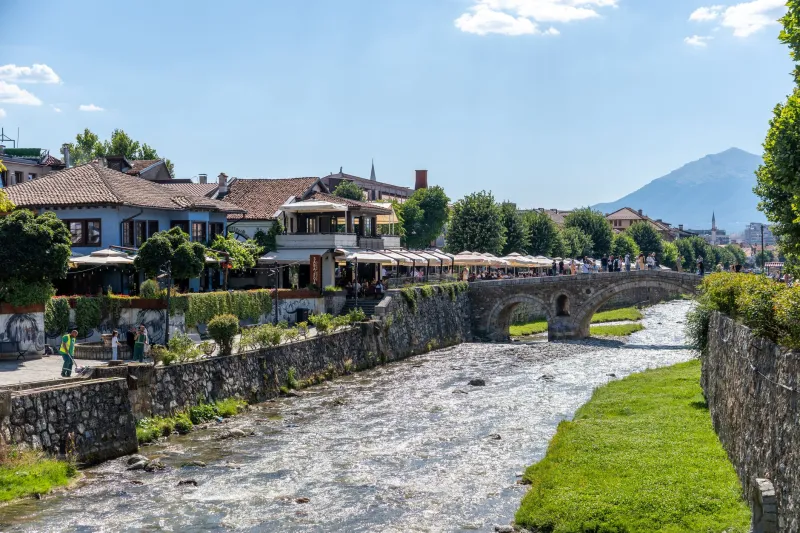
Pristina rewards extended familiarity in ways that a two-week visit cannot fully reveal. The city's café culture — centered on the long, unhurried espresso ritual that defines Kosovar social life — creates a natural infrastructure for remote work and community-building. Neighborhoods that feel indistinct on a first pass develop texture and personality over weeks of daily routine.
The food markets, the weekend rhythms of the Germia park trails, the rotating exhibitions at the National Gallery, the seasonal shifts in the outdoor dining scene along Mother Teresa Boulevard — these are the details that transform a destination into a home. American long-term residents consistently describe a deepening relationship with the city that accelerates around the three-month mark, when Pristina stops being a place they are visiting and starts being a place they understand.
A Country That Moves at Human Speed
Perhaps the most consistently cited reason Americans choose to extend their stays in Kosovo is one that resists easy quantification. Kosovo moves at a pace that many Americans describe as restorative — not slow in the sense of being underdeveloped, but deliberate in the sense of being human-scaled. Interactions carry weight. Relationships develop through repeated presence rather than scheduled networking. The architecture of daily life leaves room for the kind of unplanned encounter and genuine conversation that many Americans feel has been engineered out of existence back home.
For those who arrive in Kosovo carrying the accumulated fatigue of a life lived at maximum velocity, that quality is not a minor amenity. It is frequently the thing that keeps them.
Considering a longer stay in Kosovo? Visit visitkosova.org for practical travel information, destination guides, and resources to help you plan your journey — whether it lasts two weeks or two years.