No Map, No Tour Bus, No Problem: How Kosovo's Raw Tourism Landscape Becomes Your Greatest Asset
American travelers have been trained, over decades of packaged vacations and algorithm-driven itineraries, to expect a certain kind of frictionlessness. The hotel lobby should offer a curated restaurant list. The taxi app should work. The Instagram geotag should already exist, complete with suggested angles. Travel, in this model, is a product — and the destination is simply a backdrop.
Kosovo refuses that arrangement entirely. And for a growing number of Americans who arrive expecting friction and leave having found something far more valuable, that refusal is the destination's most compelling feature.
What Happens When the Scaffolding Disappears
Visit any major European capital and the tourism infrastructure is so thoroughly developed that it becomes nearly impossible to have an unmediated experience. Florence has been so thoroughly optimized for visitors that a first-time traveler can spend five days there and interact almost exclusively with other tourists, tour guides, and hospitality workers trained to manage volume. The city is magnificent. The encounter is managed.
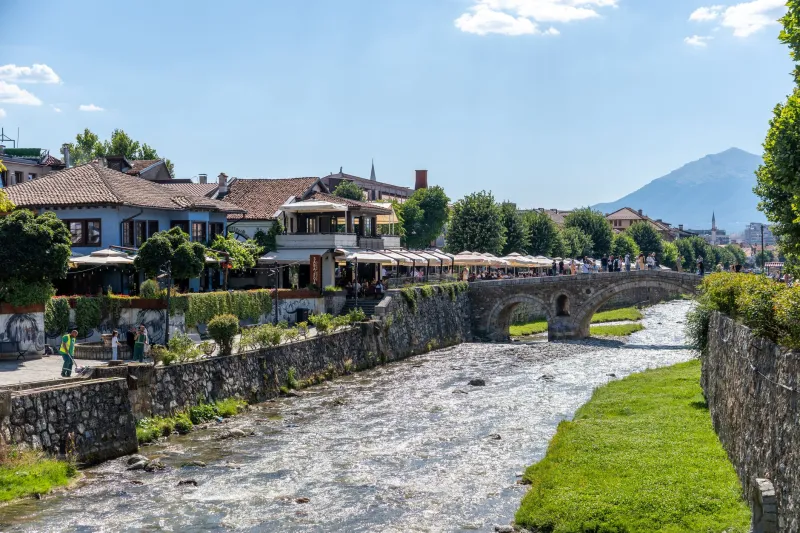
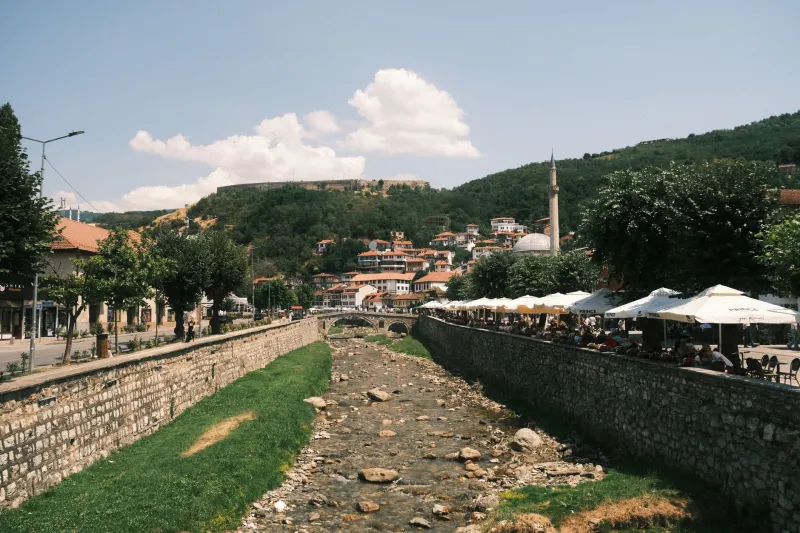
Kosovo has not reached that point — and may never choose to. There are no international hotel chains anchoring Pristina's city center with their standardized lobbies and loyalty point programs. There are no hop-on hop-off buses circling the old bazaars of Prizren. There are no laminated signs outside significant sites directing visitors to the approved photo opportunity. What exists instead is a country that has been receiving guests for centuries according to its own logic — a logic rooted in hospitality as a cultural value rather than a commercial transaction.
For Americans accustomed to paying a premium for "authentic experiences" that have been carefully reconstructed for consumption, this is disorienting at first. Then, almost universally, it becomes liberating.
The Productive Inconvenience of Having to Ask
When there is no app to consult and no tour company to defer to, the traveler must do something that modern travel culture has largely engineered away: ask another human being for help.
In Kosovo, this is not a minor logistical workaround. It is the beginning of every meaningful encounter. A question about directions to a particular village church becomes a twenty-minute conversation about the church's history, the family that maintains it, and an invitation to join someone for coffee. A request for a restaurant recommendation leads not to a Yelp-style ranking but to a personal opinion, a story about why that particular place matters, and frequently an offer to walk you there.
This is not a quirk of individual personalities. It is the expression of a culture in which the guest — the stranger who has chosen to come — carries a kind of sacred status. Kosovo's tradition of mikpritja, the Albanian ethic of hospitality, is not performed for visitors. It predates tourism entirely. The traveler who arrives without a fixed itinerary and a willingness to be redirected by circumstance will find that Kosovo's informal networks — of local knowledge, personal connection, and genuine curiosity about the visitor — function as a far richer guide than any published resource.
Undiscovered by Algorithm
One of the structural consequences of Kosovo's limited tourism infrastructure is that its most significant places have not yet been indexed by the attention economy. The waterfall outside a small village in the Rugova Valley does not have a geotag. The Ottoman-era han in Gjakova has not been featured in a travel influencer's reel. The family-run konoba where three generations cook together on a Sunday has no reservation system and no online presence.
This obscurity, which a more commercially developed destination would work aggressively to eliminate, is what makes these places what they are. The experience of discovering them is genuinely yours — not a version of an experience that ten thousand people have already documented and ranked. There is a particular quality of attention that arrives when you cannot rely on prior coverage: you look more carefully, you remember more vividly, and you carry the place with you differently because you found it through effort rather than convenience.
For American travelers who have grown quietly exhausted by the sense that every destination has already been thoroughly consumed before they arrive, Kosovo offers something that cannot be purchased or pre-loaded: the actual experience of discovery.
Building Relationships Instead of Collecting Receipts
The commercial architecture of mainstream tourism — the booking platform, the guided excursion, the souvenir shop positioned at the exit of every major site — is designed to convert the travel experience into a series of transactions. Each transaction is clean, bounded, and requires nothing of either party beyond the exchange itself.
Kosovo's tourism landscape, still largely operating outside that architecture, defaults instead to relationship. The guesthouse owner who gives you his phone number and tells you to call if anything goes wrong is not performing a service. He is extending a form of trust that carries obligation on both sides. The farmer who invites you to see his vineyard is not offering a wine tour. He is sharing something he cares about with someone he has chosen to care about.
These are not the kinds of encounters that scale. They cannot be franchised or replicated across a hotel chain. They exist precisely because Kosovo has not yet built the infrastructure that would replace them with something more efficient and considerably less human.
The Argument for Arriving Unprepared
This is not a suggestion that travelers abandon all planning. Kosovo rewards preparation — knowing some basic Albanian phrases, understanding the country's history, arriving with a general sense of its regions and their distinct characters. But there is a meaningful difference between being informed and being over-scheduled.
The traveler who arrives in Kosovo with every hour accounted for will miss the thing that Kosovo does best: the unplanned afternoon that becomes the story you tell for years. The village elder who agrees to show you something that isn't in any guidebook because you happened to be sitting near him when he finished his coffee. The detour down an unmarked road that leads to a view that has no name in any database.
Kosovo's tourism infrastructure will develop. Investment is arriving, interest is growing, and the country's ambitions for its visitor economy are genuine and well-founded. But the window in which the country exists at this particular threshold — developed enough to be accessible, undeveloped enough to be unscripted — is finite.
The travelers who arrive now, willing to trade the comfort of the pre-packaged for the reward of the genuinely encountered, will have had an experience that later visitors, arriving to a more thoroughly organized destination, will simply be unable to replicate.
That is not a limitation. That is the offer.