Sacred Walls, Layered Truths: Kosovo's Medieval Monasteries and the Art of Sitting With Complexity
There is a particular kind of travel experience that does not resolve neatly into a postcard. You stand inside a medieval church, surrounded by frescoes so luminous they seem lit from within, and you feel the full weight of centuries pressing against you—not just the centuries of artistry, but the centuries of conflict, claim, and counter-claim that have made this building one of the most contested cultural sites in Europe. Kosovo's great monasteries offer exactly that experience. They are simultaneously among the most magnificent medieval structures on the continent and among the most politically charged. For American visitors, they represent something genuinely difficult to find in modern travel: a place that demands intellectual engagement rather than passive admiration.
Visoki Dečani: A Cathedral in the Wilderness
Drive south from Peја/Peć toward the Albanian border and the landscape gradually narrows into forested canyon walls. There, set against a backdrop that feels almost theatrical in its drama, stands the Monastery of Visoki Dečani. Built in the fourteenth century under Serbian King Stefan Dečanski and completed by his son Emperor Dušan, Dečani is the largest surviving medieval church in the Balkans. Its exterior is an extraordinary marriage of Romanesque and Byzantine traditions—white and rose marble alternating in horizontal bands, carved portals dense with biblical imagery, a structure that somehow manages to feel both monumental and intimate.
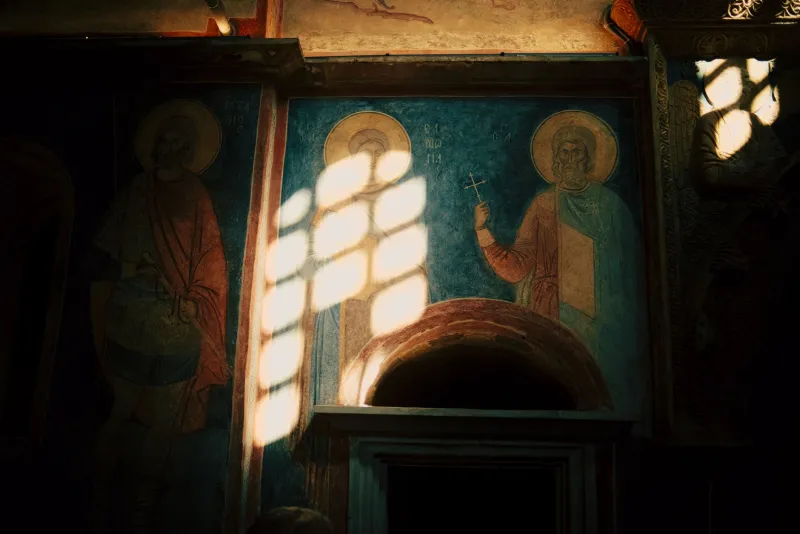
Step inside and the effect is overwhelming. More than a thousand fresco compositions cover virtually every surface, constituting one of the most complete cycles of medieval painting in existence. The figures are rendered with a psychological intensity that feels startlingly modern: saints whose eyes carry genuine sorrow, narrative scenes whose spatial logic anticipates the Renaissance by decades. Art historians from around the world travel to Dečani specifically to study these paintings. Most American visitors have never heard of the place.
Dečani is a UNESCO World Heritage Site, inscribed as part of the broader designation of Medieval Monuments in Kosovo. It is also a site where NATO peacekeeping forces maintained a protective presence for years following the 1999 conflict—a detail that tells you something important about the stakes involved. The monastery remains an active Serbian Orthodox community. Monks still live, pray, and work here. Visitors are welcome, but the atmosphere calls for a certain quietness of spirit.
Gračanica: Geometry as Theology
Near the town of Lipjan/Lipljan, just south of Pristina, Gračanica Monastery rises from the Kosovo plain with a silhouette so distinctive it has become one of the country's most recognizable images. Commissioned by Serbian King Milutin in the early fourteenth century, Gračanica represents Byzantine ecclesiastical architecture at perhaps its most refined—a cascading system of domes and semi-domes that creates an almost musical sense of rhythm when viewed from the outside, and a soaring, light-filled interior when experienced from within.
The frescoes at Gračanica are somewhat less complete than those at Dečani, partly due to the depredations of the centuries, but what remains is exceptional. Royal portraits, scenes from the life of Christ, and elaborate genealogical compositions that served both devotional and political purposes are all present. Like Dečani, Gračanica is a UNESCO-listed monument and an active place of worship.
What makes Gračanica particularly compelling for the thoughtful American visitor is its location. Unlike the relative isolation of Dečani, Gračanica sits within a largely Albanian-majority municipality, surrounded by a community that has its own relationship—sometimes tense, sometimes pragmatic—with the monastery's presence. The site is accessible, the monks and staff accustomed to international visitors, and the short distance from Pristina makes it an easy half-day excursion. That accessibility also means you can engage more directly with the layered present-tense reality of the place, not just its medieval past.
The Churches of Prizren: Heritage in a Divided Landscape
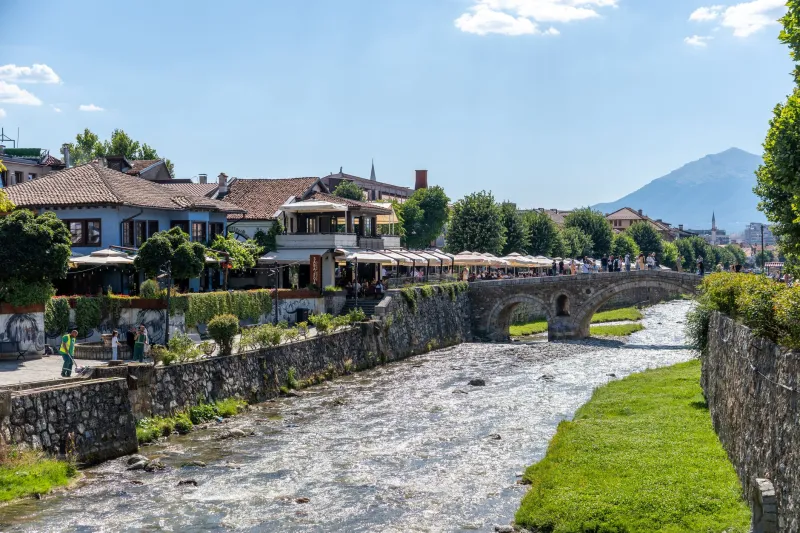
Prizren is Kosovo's most historically layered city, and its religious architecture reflects that complexity with particular intensity. The Church of Our Lady of Ljeviš—another UNESCO-listed medieval monument—sits in the old town, its fourteenth-century frescoes partially obscured by the whitewash applied during centuries of Ottoman use as a mosque. The process of restoration has been painstaking, the results extraordinary. Fragments of Byzantine painting emerge from beneath the plaster like memories returning to the surface.
In March 2004, during a wave of inter-ethnic violence, several Orthodox churches in Prizren were damaged or destroyed. The scars of that period are still visible in some locations, and the subject remains sensitive. It would be dishonest to present Prizren's religious heritage without acknowledging this history. But it would be equally dishonest to reduce these sites to symbols of conflict alone. They are, first and foremost, works of art of the highest order—and they are slowly, carefully being restored.
What It Means to Witness Without Resolving
Americans are, by cultural habit, solution-oriented. We tend to approach complicated situations with the expectation that sufficient information will yield a clear answer. Kosovo's monasteries resist that framework. The Serbian Orthodox Church regards these sites as the spiritual and architectural heart of Serbian civilization. The government of Kosovo, and the majority of the country's population, regards them as part of Kosovo's national heritage—a heritage that belongs to the territory regardless of the ethnic or religious identity of those who built it. Both claims are sincerely held. Neither fully cancels the other.
For a visitor, the most honest approach is neither to adjudicate between these positions nor to pretend the tension doesn't exist. It is to stand in front of a thirteenth-century fresco of the Dormition of the Virgin, rendered in colors that have survived seven hundred years of history, and allow the experience to be what it actually is: beautiful, complicated, and irreducible.
That capacity—to hold beauty and complexity simultaneously—is something travel at its best can genuinely cultivate. Kosovo's monasteries are among the world's most demanding and rewarding classrooms for developing it.
Planning Your Visit
All three major monastery sites—Dečani, Gračanica, and the churches of Prizren—are accessible to international visitors. Modest dress is expected at all sites; shoulders and knees should be covered, and visitors should maintain a respectful demeanor, particularly during services. Photography policies vary by location and should be confirmed on arrival.
Guided tours from Pristina can be arranged through reputable local operators and are strongly recommended for visitors who want historical and cultural context. Independent travel is also feasible; Gračanica is the easiest to reach by public transport, while Dečani requires a car or organized tour. The roads are generally well-maintained, and the drives themselves pass through some of Kosovo's most striking countryside.
Visiting these sites is not a politically neutral act—but then, very little in Kosovo is. What it is, unambiguously, is an encounter with some of the most significant medieval art in the world, in a country that has rarely received the recognition it deserves.